
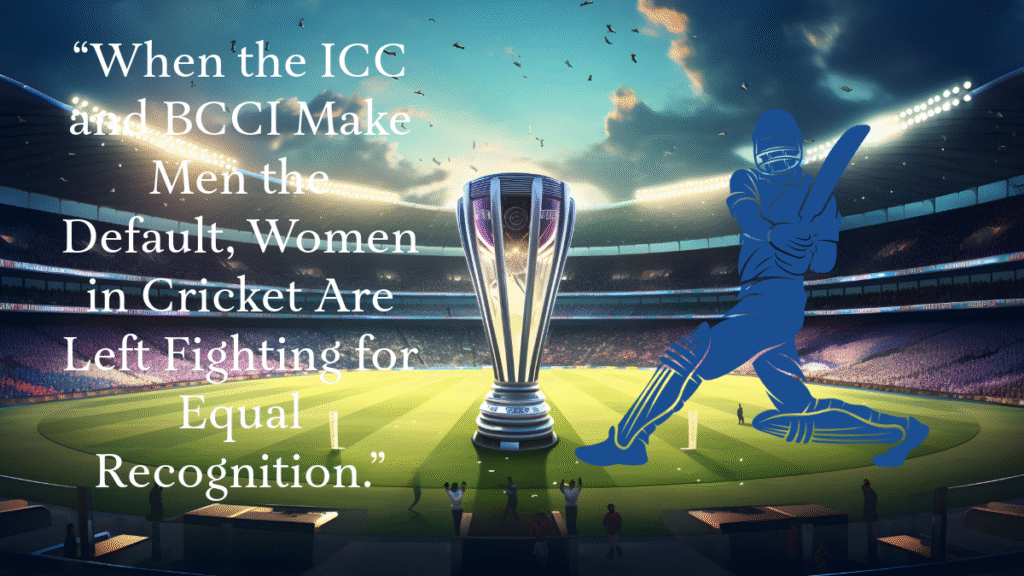
(A Thought on Gender Equality in Cricket)
The Question That Wouldn’t Leave My Mind
As the Women’s Cricket World Cup unfolds, I’ve been cheering for every boundary, every wicket, and every proud moment on the field. But somewhere between those overs, a thought struck me — a simple, almost innocent question that refused to go away.
Why do we call it “The World Cup” for men, but “The Women’s World Cup” for women?
And why is it always “The Indian Cricket Team” for men, but “The Indian Women’s Cricket Team” for women?
It might sound small, but language has power. What we name things often reflects what we value — and what we unconsciously don’t.
When Words Become Walls
Cricket is a religion in India. It unites us across languages, states, and even emotions. But when it comes to recognition, the balance tilts.
When someone says “Team India,” we picture Rohit Sharma, Virat Kohli, Jasprit Bumrah — not Harmanpreet Kaur or Smriti Mandhana. And that’s not because women’s cricket is less talented or less passionate — it’s because the system named it that way.
The default in our minds became male.
The women, even when they play the same game, wear the same jersey, and represent the same flag — became the “other version.”
It’s subtle discrimination, yes. But subtle discrimination is still discrimination.
The Power of Naming: Why Language Matters
Names are not just labels. They shape identity.
When you constantly remind a group that they are an “exception” to the rule, you also remind the world that the rule was never meant to include them fully.
If we keep calling it the “Women’s World Cup,” we’re unknowingly saying that men’s cricket is the default, and women’s cricket is the variation.
Why can’t both tournaments be called “Men’s Cricket World Cup” and “Women’s Cricket World Cup” — or better yet, simply “World Cup (Men’s)” and “World Cup (Women’s)”?
Equal, balanced, fair.
Because the word World belongs to both.
Cricket Boards and the Quiet Bias
The International Cricket Council (ICC) and the Board of Control for Cricket in India (BCCI) have made progress — more tournaments, more exposure, and more pay equity steps. But this language issue remains unchanged.
If official boards still label women as an afterthought, how can we expect the public to see them as equals?
If Team India (Men) is the brand and Team India (Women) is the footnote, equality becomes a slogan, not a system.
The Public Mirror: We Imitate What We See
People mirror institutions. If BCCI and ICC set different labels, the audience will too.
You’ll hear people say:
“Are you watching the India match?” (meaning the men’s game)
“Oh, the women are playing today?” (as if it’s a side event)
This is how bias hides — not in loud words, but in quiet habits.
And the result?
Less coverage, fewer sponsorships, smaller crowds. Not because women’s cricket is less exciting — but because it’s treated as less normal.
What True Equality in Cricket Could Look Like
Imagine a future where both tournaments are announced like this:
ICC Men’s Cricket World Cup 2027
ICC Women’s Cricket World Cup 2029
Simple. Equal. Balanced.
No team becomes the default; both are part of the same world of cricket.
And imagine hearing commentators say:
“Team India is playing Australia today,” without needing to specify gender — because both teams, men’s and women’s, are celebrated equally in the nation’s heart.
That’s not just linguistic progress — it’s cultural progress.
It’s Not About Blame — It’s About Awareness
This isn’t to shame cricket boards or fans. It’s to start a conversation. Because most discrimination isn’t born out of hatred — it’s born out of habit.
We’ve accepted these naming patterns for so long that we stopped questioning them. But change always begins with a question — even a small one.
Cricket Is for Everyone — Language Should Be Too
Cricket doesn’t care about gender. The ball doesn’t swing differently for women. The passion, the pressure, the pride — it’s the same.
So why should the title sound different?
If the sport truly belongs to everyone, then our words should too.
My Hope for the Future
One day, I hope a little girl growing up in India can say,
“I want to play for Team India,”
and no one needs to ask, “Men’s team or women’s?”
Because by then, there won’t be a “men’s” and “women’s” in the conversation — just cricket, just India.
Follow me on social media for daily Navratri inspiration.
Read my novel on Amazon — a journey of storytelling you’ll enjoy.
Visit my website for more blogs.
Sports & Society, Gender Equality, Cricket, Opinion, Culture & Media
gender bias in cricket, world cup equality, women’s cricket, bcci discrimination, cricket and gender, team India women, icc world cup, language and equality, sports gender gap, women in sports